
Product Strategy & Roadmapping
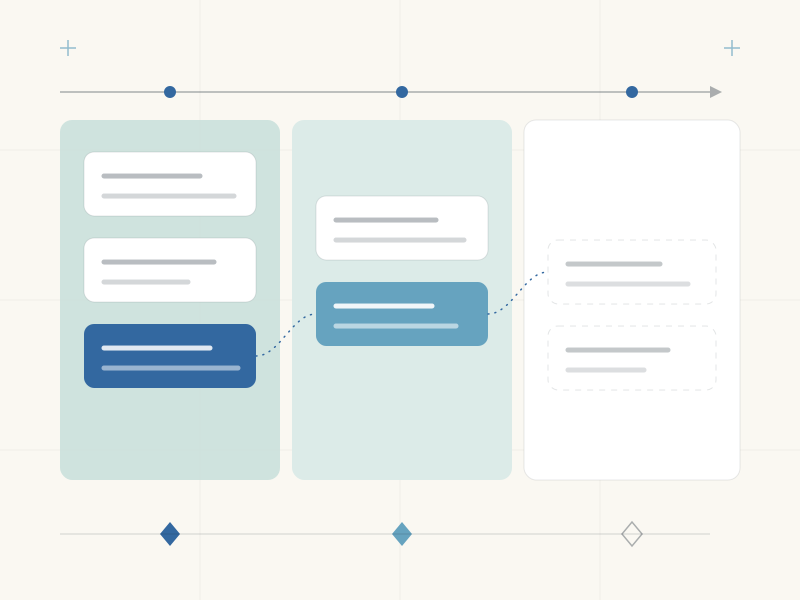
Product Strategy & Roadmapping at a glance
Businesses with more product ideas than capacity to build them
A prioritised roadmap and a three-year product strategy
Strategy engagement ending in leadership commitment
This Is for You If…
- Businesses with more ideas than capacity, and no way to choose
- Product ranges grown by accumulation, not design
- Flagship products ageing while competitors move
- Leadership teams needing defensible investment priorities
- Founders planning the next three years of product development
Sound Familiar?
- Every department wants something different built next
- Overlaps, gaps and products nobody reviews
- Improvements happen only when customers complain
- Investment spread thinly across too many directions
- No shared answer to “where is the product line going?”
Capabilities Within This Service.
- Product roadmap development (12-month and 3-year horizons)
- Three-year product strategy
- Product portfolio strategy and rationalisation
- Feature prioritisation and commercial prioritisation
- Product opportunity mapping
- Product lifecycle and upgrade planning
- Investment priorities and innovation pipeline design
- New category opportunity assessment
What You Receive.
A prioritised product roadmap with reasoning attached to every item
Three-year product strategy document for leadership alignment
Portfolio review: what to grow, maintain, fix or retire
Feature and improvement priority stack with commercial rationale
Innovation pipeline structure for opportunities beyond the roadmap
How This Engagement Runs.
-
Audit the portfolio
Current products, their performance, their position against competitors and their role in revenue.
-
Gather the evidence
Customer needs, competitor movement, market trends and cost realities — often building on Market & Customer Intelligence work.
-
Map the options
Improvements, upgrades, new products and category opportunities, each assessed for value, effort and risk.
-
Sequence and commit
A roadmap your leadership team has debated and agreed — with clear reasoning for what was deprioritised and why.
Questions This Service Answers.
For Those Who Want the Thinking.
A roadmap is not a strategy
A product roadmap is a sequence: what gets built or improved, in what order, over roughly the next twelve months. A product strategy is the reasoning above it: which customers and segments you intend to win, what your products must be demonstrably better at, and where the portfolio should be in three years.
A roadmap without a strategy becomes a queue of requests — whoever argues loudest gets built first. A strategy without a roadmap stays a slide nobody executes. ZENO builds both, and keeps them connected: every roadmap item traces back to a strategic reason, and the strategy is revisited as the market moves.
One-year decisions, three-year direction
Twelve-month thinking answers operational questions: which improvements ship this year, which costs get engineered out, which product gets refreshed. Three-year thinking answers structural ones: which categories to enter, which technologies to prepare for, which products to eventually retire, and what capability the business must build to stay competitive.
Most companies do the first informally and the second not at all. The result is a product line that evolves by accretion — and is eventually outflanked by a competitor who planned. ZENO’s roadmapping work deliberately holds both horizons, so short-term choices build toward a defined destination.
Prioritisation is a commercial act
Feature prioritisation is often treated as a technical exercise. It is really a commercial one: every item on a roadmap is an investment decision competing for limited engineering, tooling and management attention.
We prioritise against explicit commercial criteria — customer value, differentiation, margin impact, cost, risk and strategic fit — and we document the reasoning, so priorities survive the next loud opinion in a review meeting.
Frequently Asked Questions.
What is the difference between a product roadmap and a product strategy?
A roadmap is the sequenced plan of what to build and improve, typically over 12 months. A strategy is the reasoning behind it: which markets and customers you intend to win, how your products will be better, and where the portfolio should be in three years. ZENO builds both and keeps them connected.
How long does a product strategy engagement take?
It depends on portfolio size and how much research already exists. A focused roadmap for a single product line moves faster than a full portfolio strategy. We scope the engagement around the decisions you need to make and when you need to make them.
Can you help prioritise between existing product ideas?
Yes. Many clients arrive with a long list of ideas and no agreed way to rank them. We assess each against customer evidence and commercial criteria, and facilitate the leadership decision so the output is a commitment, not another list.
Does this work for hardware and physical products?
Yes — physical, industrial and consumer products are our core focus. Roadmapping for physical products has constraints software rarely faces (tooling, certification, inventory, supplier lead times), and our prioritisation reflects those realities.
Give your product line a direction worth committing to.
If your team is debating what to build next — or hasn’t had that debate in too long — a structured strategy engagement will settle it with evidence.